Smart City Solutions

AI Violence Detection & Public Safety System

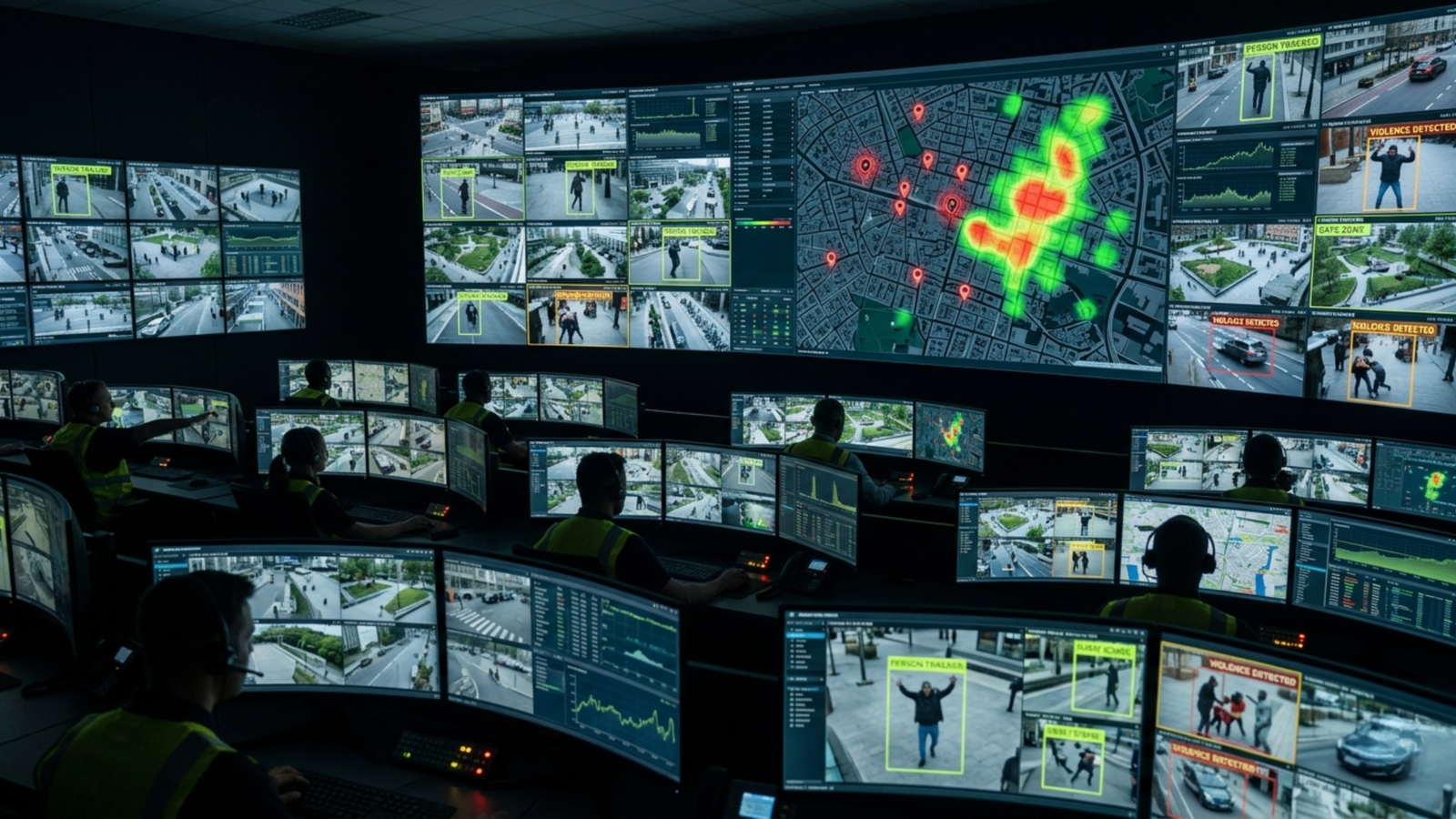
Modgenix was engaged by a leading private real estate and urban development company in Kazakhstan to design and deploy a comprehensive AI-powered violence detection and threat intelligence system as part of a large-scale Smart City modernization project in a major urban development. The system has been deployed across an extensive network of private urban surveillance infrastructure, including commercial districts, residential complexes, public transport hubs, shopping centers, and educational institutions. It delivers real-time automated detection of violent incidents, threatening behavior, and weapon presence, enabling faster emergency response, proactive threat prevention, and intelligent safety resource allocation.

Name:

Private Client

Categories:

AI · Computer Vision · Public Safety · Edge Computing

Location:

Confidential — Republic of Kazakhstan

Date:

February 2026

Status:

Ongoing Partnership

Duration:

03 Months (Ongoing)

Working Process

Challenge of this Case

Building an AI violence detection system that operates reliably at scale — across thousands of cameras, in varied lighting and weather conditions, across culturally diverse populations, with zero tolerance for critical misses on genuine violent incidents, while maintaining acceptable false alarm rates for emergency response teams — is one of the most technically demanding applications of computer vision AI in existence.

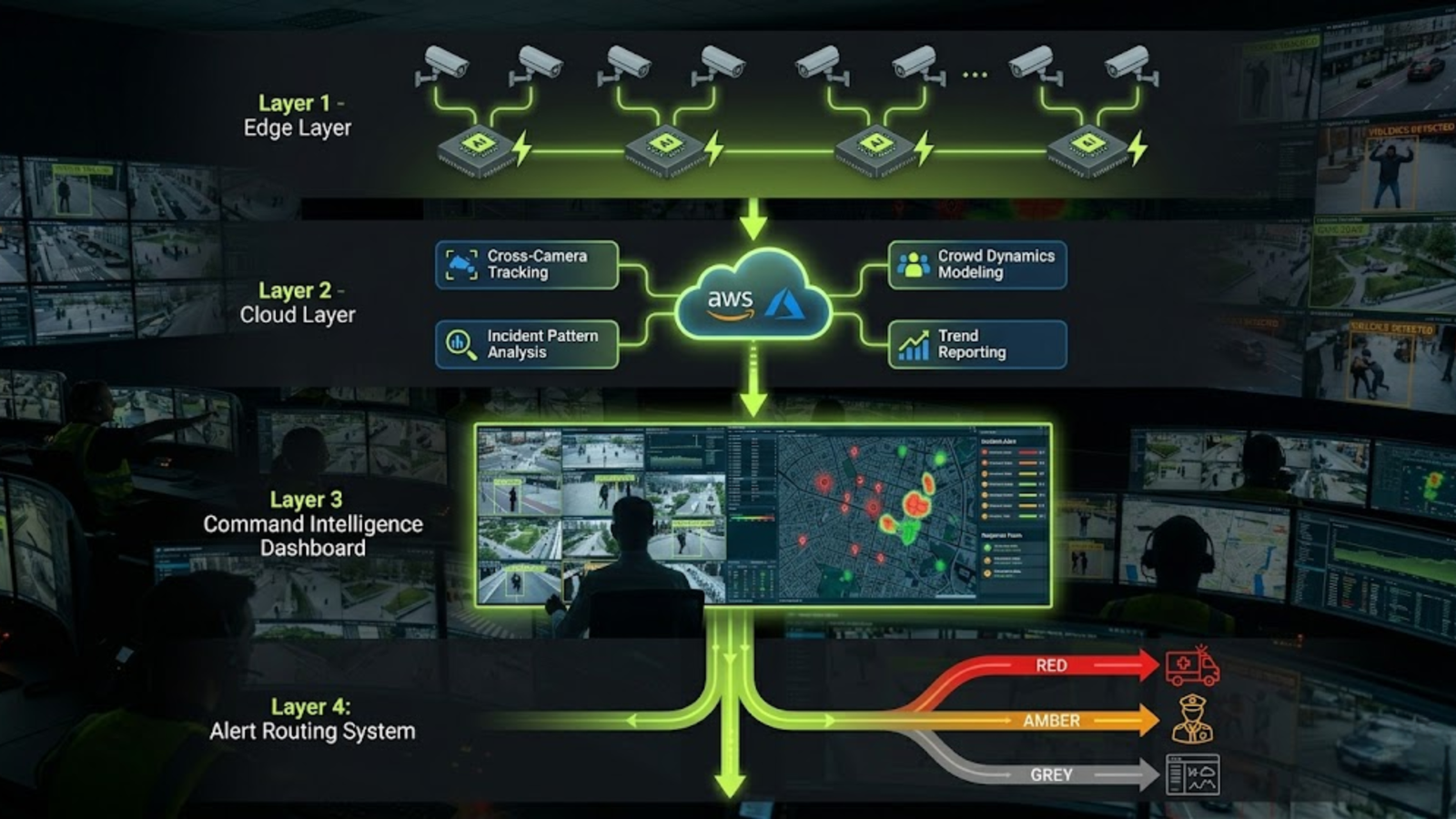
TECHNICAL ARCHITECTURE

image

DETECTION CAPABILITIES

The AI system detects and classifies the following threat categories in real time:

Physical Violence Detection

Automated detection of physical assault, fighting, and battery incidents between individuals — including one- on-one confrontations, group fights, and mob violence scenarios in public spaces. The system distinguishes between playful/sporting physical contact and genuine violent assault through biomechanical motion analysis and contextual environmental assessment.

Street Fight & Group Violence Detection

Specialized models trained specifically on street fight dynamics — including the escalation patterns that precede group violence, crowd clustering behavior associated with fight formation, and the rapid directional movement patterns characteristic of mass brawl incidents. Early detection of pre-violence escalation patterns enables preventive intervention before fights begin.

Weapon Detection & Firearms Recognition

Real-time detection of visible firearms including handguns, rifles, and shotguns — as well as edged weapons including knives and bladed instruments — in public space video feeds. The weapon detection model operates across varied carry positions (drawn, holstered-visible, raised) and partial occlusion scenarios common in real surveillance footage.

Abusive & Threatening Behavior Detection

Detection of aggressive posturing, threatening gestures, and confrontational behavioral patterns that precede physical violence — enabling proactive dispatch before situations escalate. Includes detection of intimidation behavior, pursuit behavior, and territorial confrontation patterns in public spaces.

Crowd Density & Anomaly Detection

Real-time crowd density mapping and anomaly detection that identifies sudden crowd dispersal (stampede indicator), abnormal crowd gathering patterns, and perimeter intrusion events around secured areas — providing crowd safety intelligence beyond individual incident detection.

Abandoned Object Detection

Detection of unattended bags, packages, and objects in sensitive public locations — flagging items left beyond defined time thresholds in transport hubs, civic buildings, and event venues for security officer investigation.
FAQ

Frequently asked questions

Everything you need to know about working with Modgenix — from how we engage to how we deliver results across every service we offer.

The core AI challenge in violence detection is the enormous visual similarity between many violent actions and normal human activities — hugging and grabbing, running away from danger and chasing, construction workers handling tools and weapon brandishing. We solved this through a multi-modal classification approach combining skeletal pose estimation, motion trajectory analysis, interaction distance and velocity modeling, and contextual environment classification — with the final classification decision made by an ensemble model trained on 1.2M+ annotated video clips spanning genuine violent incidents and visually similar non-violent scenarios.
Training data diversity was a primary concern from the outset of the project. The training dataset was constructed with deliberate demographic diversity covering age, gender, body type, cultural dress, and ethnicity — ensuring the models perform consistently across Kazakhstan's diverse urban population. Bias audit protocols were run at each model version milestone, with targeted dataset augmentation applied wherever performance disparities across demographic groups were identified.
The alert system implements a tiered confidence threshold architecture. Alerts generated above the high-confidence threshold trigger immediate emergency response notification. Alerts in the medium-confidence range trigger a 30-second human operator review window before dispatch — allowing an experienced operator to confirm or dismiss the alert before response resources are committed. Low-confidence flags are logged for pattern analysis without generating operational alerts.
The system was deployed under a formal legal and ethical governance framework established by the client authority — including defined lawful processing purposes, data retention limits, access audit requirements, and independent oversight mechanisms. Modgenix provided technical privacy-by-design architecture including no facial recognition capability in the deployed system, automatic video data purging beyond defined retention periods, and comprehensive access logging for all operator interactions with the system.
Yes — the modular AI architecture was designed specifically to support the addition of new detection capabilities without requiring a complete system rebuild. New detection modules can be developed, validated, and deployed to the edge infrastructure through the centralized MLOps pipeline. The client authority has a defined roadmap of capability extensions being developed by Modgenix under the ongoing partnership agreement.